
 EN
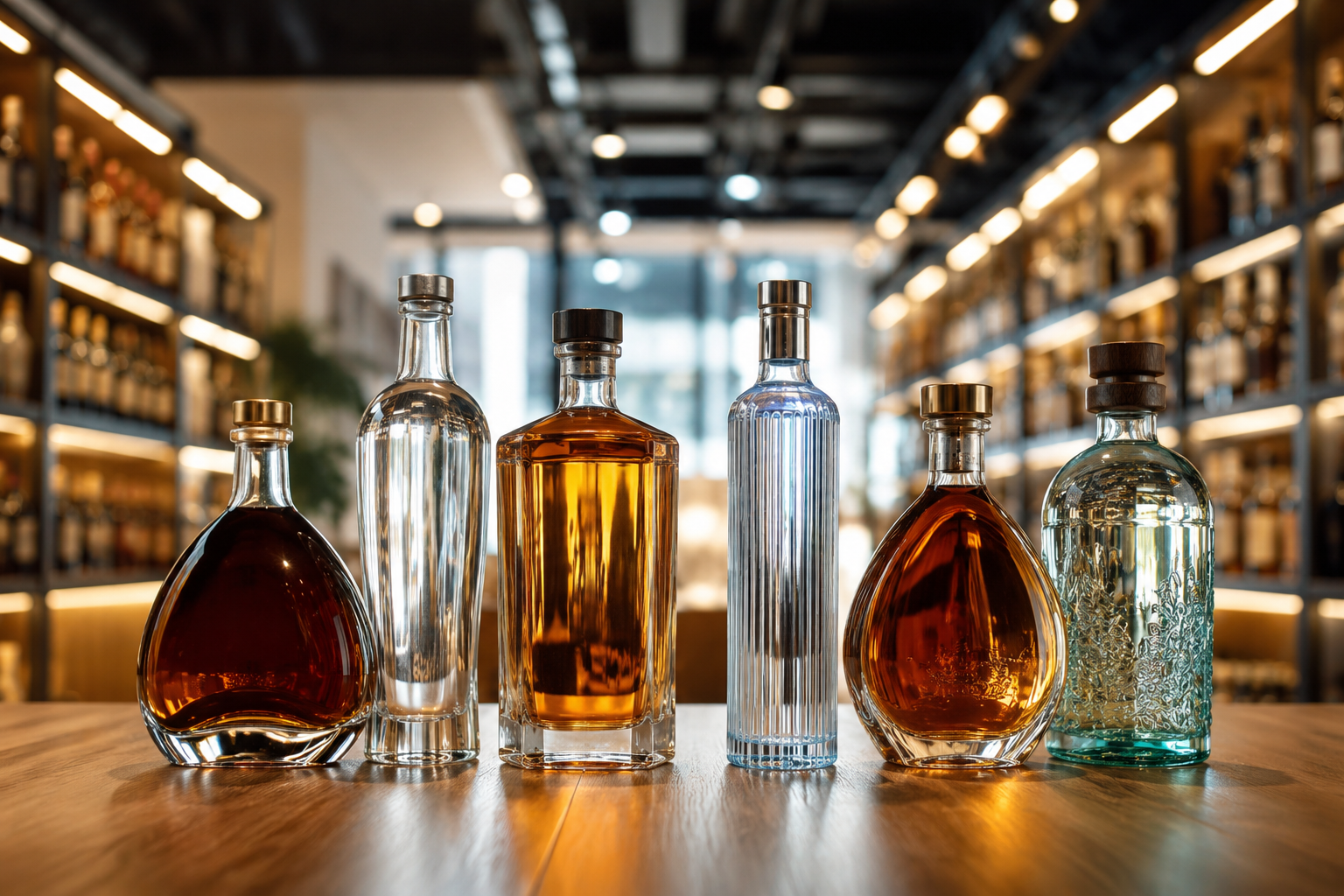
Why Custom Spirit Bottle Shapes Strengthen Brand Identity
The Psychology of Silhouette Recognition on Shelf Impact
In premium spirits, the bottle is often the first and last communication. A unique silhouette triggers rapid, nonconscious recognition on a crowded back bar or retail shelf—consumers scan in seconds, and distinctive profiles act as visual anchors amid dozens of standard round or rectangular formats. Shape becomes a memory shortcut, supporting recall after initial exposure. Curved shoulders, heavy bases, or embossed panels signal craft and gravity before a label is read. This silhouette-driven recognition also reinforces price justification: nonstandard glass profiles read as intentional and premium, shifting attention from liquid alone to total product experience. For distilleries, silhouette is not decoration—it’s a strategic brand asset influencing speed of recognition, perceived quality, and repeat selection. Even at distance, a proprietary shape can trigger recall and cut through competitive clutter.
Case Study: A Pacific Northwest Distillery’s Cascadian Oak Spirit Bottle as Origin Story in Form
One regional distillery translated its geographic identity into a distinct bottle profile: a tapered body echoing conifer growth and a broad shoulder suggesting Pacific Northwest canopies. Molded ridges mimic tree bark; amber glass evokes aged oak and forest floor. This form communicates origin, climate, and barrel character before a word is read—transforming the bottle into a narrative object. Because the silhouette is proprietary, it earns premium shelf placement and serves as a visual shorthand for the distillery’s regional style. The case underscores how custom profiles convert geography into a tangible selling point—reducing reliance on labels or secondary packaging. For brand owners, it reaffirms the strategic value of tooling investment: a well-designed spirit bottle carries origin, craft, and story in a single, defensible silhouette.
The Spirit Bottle Manufacturing Journey: From Design to Production Reality
Design Feasibility: Navigating Moldability, Wall Thickness, and Fill Integrity
Design feasibility determines whether a striking silhouette survives commercial filling, labeling, and transport. Moldability starts with draft angles—every vertical surface needs at least 1.5–2 degrees of taper for clean mold release. Wall thickness is equally critical: deep embossing or sharp corners trap glass unevenly, creating thin stress points. Manufacturers target a minimum sidewall of 2.0–3.0 mm and a heavier base to lower the center of gravity. Fill integrity depends on capacity, headspace, and closure torque. Deviations from common neck finishes (e.g., 18.5 mm or 20 mm) may require costly change parts on filling lines. Similarly, narrow shoulders or exaggerated punts slow rinsing and reduce throughput. Annealing lehr temperature profiles rely on uniform wall distribution—uneven sections cool at different rates, causing residual stress. Early prototyping with 3D-printed models and IS machine trials prevents expensive tooling errors. Refining form for manufacturability before cutting steel avoids cracks, unstable filling, and high line rejection rates.
Lead Time, MOQs, and Cost Implications of Custom Spirit Bottle Tooling
Custom tooling shifts the cost calculus from per-unit price to upfront capital. A single mold set typically costs $5,000–$20,000, depending on cavity count, embossing depth, and neck complexity. Lead time from CAD approval to first article samples spans 8–12 weeks, with full production following 4–6 weeks after sample sign-off. MOQs are driven by furnace pull and color campaigns: clear flint glass often allows minimums as low as 10,000 units per run, while custom colors or extra-heavy bases may push MOQs to 30,000+. Brands can optimize this by bundling multiple SKUs into one tooling investment—shared base molds with varying neck finishes, labels, or closures maintain flexibility without new molds. Distillers should request an all-in cost sheet separating mold amortization, unit glass price, decoration, and freight. Comparing that landed cost against stock alternatives clarifies whether the branded silhouette delivers sufficient margin and differentiation.
Strategic Collaboration: Aligning Distillery Vision with Glass Manufacturer Capabilities
Successful custom spirit bottle programs depend on early alignment between distillery teams and glass manufacturing engineers. Distilleries bring brand narrative, audience insight, and shelf-position goals; manufacturers contribute mold engineering, material behavior, and production feasibility. When both sides collaborate before finalizing artwork or dimensional drawings, the result is a bottle that is distinctive and manufacturable—without excessive tooling risk.
At the core is a shared technical language. Distilleries should ask potential partners about consistent production capacity, automated inspection systems, and support for diverse formats—from premium 200ml to 500ml bottles alongside standard inventory. A manufacturer with strict QA protocols and design flexibility is better equipped to translate a brand’s silhouette into a stable, repeatable glass form.
Practical collaboration includes 3D modeling and prototyping before mold cutting. Digital visualization helps confirm the bottle’s shelf presence, alignment with target consumers, and compatibility with sustainability goals—such as dark glass reinforcing whiskey’s aged luxury, or clear glass signaling purity for gin or vodka. The best outcomes treat manufacturing constraints not as limitations, but as creative boundaries.
Beyond Shape: Integrated Customization for Premium Spirit Bottle Differentiation
Tactile Embossing, Sustainable Closures, and NFC-Enabled Smart Caps
A premium spirit bottle becomes a multi-sensory asset when decoration, closure, and digital features align. Tactile embossing adds raised brand marks or texture to the glass surface, enhancing shelf recognition through touch. Sustainable closures—like recycled-content caps, lighter alloys, or natural cork alternatives—maintain seal integrity while reducing environmental impact. NFC-enabled smart caps link the physical bottle to digital content, allowing consumers to verify authenticity, access serving suggestions, or explore distillery stories with a tap. These elements work best when chosen together: embossed glass anchors brand identity, sustainable closures signal responsible sourcing, and NFC caps extend engagement post-purchase. For distillers, combining them with a custom shape creates a cohesive premium experience—without over-relying on label graphics. Pre-production samples help confirm visual and functional alignment, ensuring every detail supports the brand’s strategic intent.
FAQ Section
Why is the shape of a spirit bottle important for branding?
The shape of a spirit bottle plays a crucial role in branding as it triggers rapid recognition, supports recall, and conveys perceived quality and craft. Distinctive shapes act as visual anchors in competitive retail spaces.
What are the key factors in designing a custom spirit bottle?
Key factors include moldability, wall thickness, draft angles for mold release, fill integrity, and the balance between creative aesthetics and production feasibility.
How much does custom spirit bottle tooling cost?
Custom spirit bottle tooling costs typically range between $5,000 and $20,000, depending on cavity count, embossing details, and neck complexity.
What is the lead time for producing custom spirit bottles?
The lead time generally spans from 8–12 weeks for CAD approval to first sample production, with an additional 4–6 weeks for large-scale production.
How do manufacturers and distilleries collaborate on custom bottle designs?
Collaboration involves aligning brand narratives with manufacturing constraints, using 3D modeling, prototyping, and early discussions on technical feasibility to ensure a striking yet manufacturable result.
Table of Contents
- Why Custom Spirit Bottle Shapes Strengthen Brand Identity
- The Spirit Bottle Manufacturing Journey: From Design to Production Reality
- Strategic Collaboration: Aligning Distillery Vision with Glass Manufacturer Capabilities
- Beyond Shape: Integrated Customization for Premium Spirit Bottle Differentiation
-
FAQ Section
- Why is the shape of a spirit bottle important for branding?
- What are the key factors in designing a custom spirit bottle?
- How much does custom spirit bottle tooling cost?
- What is the lead time for producing custom spirit bottles?
- How do manufacturers and distilleries collaborate on custom bottle designs?