EN


For years, the lightweighting conversation in spirits packaging was framed as a trade-off: save weight, sacrifice presence. That framing is now obsolete.
The data from 2024–2026 tells a different story. Distillers are actively seeking weight reductions of 15–30% to lower freight costs and carbon footprints, and glass manufacturers that invest in narrow-neck press-and-blow (NNPB) technology are capturing premium contracts as a result. Lightweight glass adoption in the US spirit glass packaging market is projected to rise from 20–25% of bottle volume today to 35–45% by 2035, driven by both cost and sustainability pressures.
The operative question for spirits bottle buyers in 2026 is not whether to lightweight. It is how to lightweight intelligently—capturing the cost, logistics, and sustainability gains without introducing breakage risk or diluting the premium cues that justify a spirits brand’s price point.
1. Cost: Where the Savings Actually Come From
The most direct cost lever is glass itself. Industry benchmarks indicate that lightweight glass can be priced 15–30% below standard and luxury glass equivalents. For a 700ml spirits bottle where glass represents the single largest component of packaging cost, that differential compounds quickly across annual volume.
A documented case study illustrates the scale. CleanCo, a UK non-alcoholic spirits brand, undertook a structural redesign that reduced bottle weight by 13%. The result was approximately £140,000 in annual savings across materials and freight costs, alongside a reduction of 120 tonnes of CO₂ per year. The redesign also consolidated multiple moulds into a single ultralightweight mould serving all SKUs, cutting tooling costs and streamlining production.
EPR Fees: The Emerging Cost Line Item
Extended Producer Responsibility (EPR) legislation is turning packaging weight into a recurring compliance cost. In markets where EPR schemes are active, the weight of glass placed on the market directly influences the fees a brand pays.
Croxsons' Rightweight® programme demonstrates the linkage explicitly. The company's 330ml Rightweight Mountain bottle delivers a 9.5% weight reduction per bottle and offers "potentially significant" reductions in EPR fees. More relevant for spirits buyers, the company's premium Apollo 700ml spirits bottle was reduced from 575g to 400g—a 30% weight reduction—through the same technology. For a brand shipping hundreds of thousands of units into EPR-regulated markets, the fee differential between a 575g and a 400g bottle is not marginal. It is a structural cost advantage.
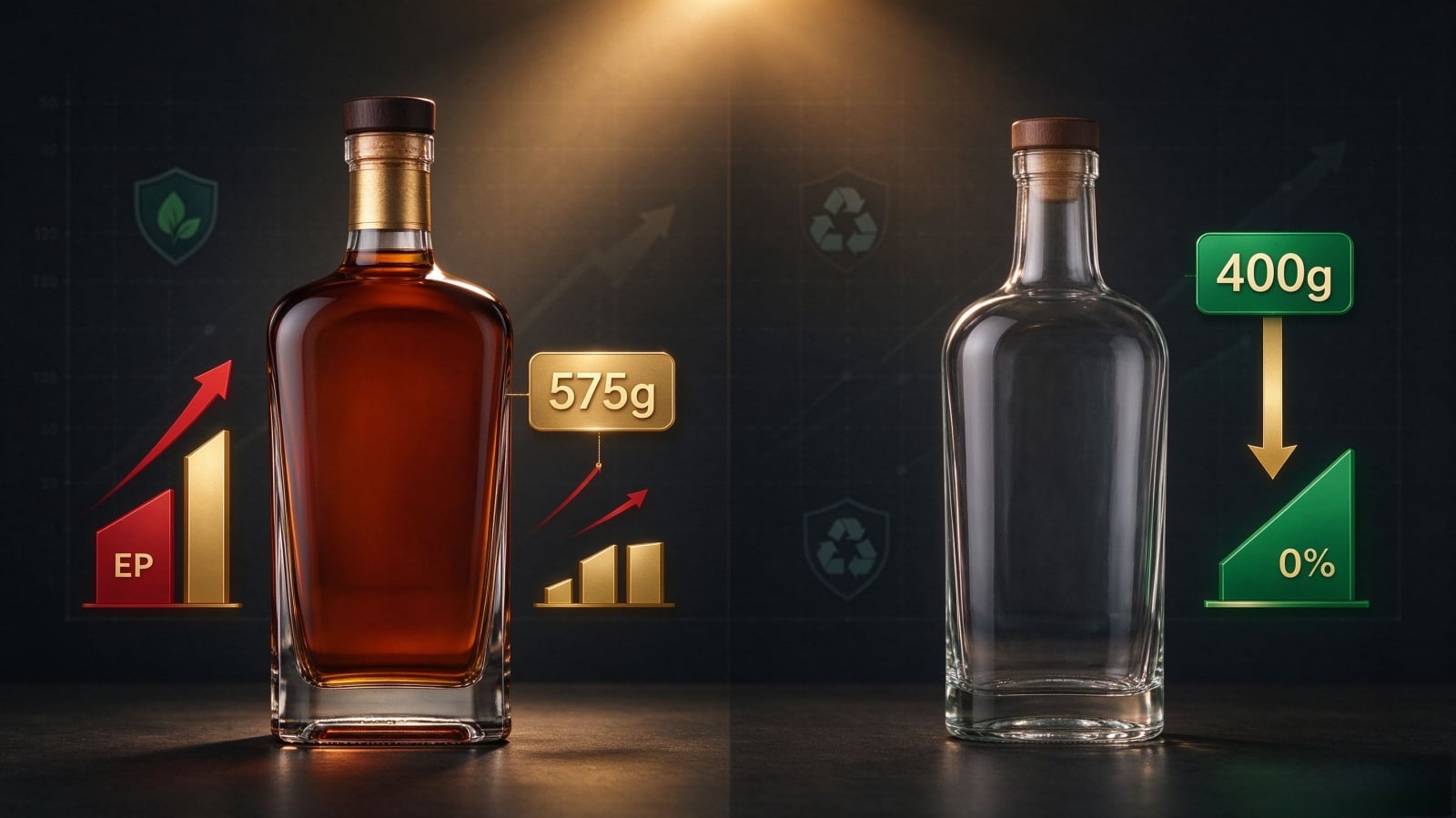
Cost savings from lightweighting are real, but they are not automatic. They depend on three specification decisions: (1) whether the lightweight option uses an existing mould or requires new tooling; (2) whether the decoration process is compatible with thinner walls; and (3) whether the order volume justifies the transition. Buyers should request a total cost of ownership comparison covering glass unit price, freight per container, EPR fee differential, and any mould amortisation—not simply a per-bottle quote.
2. Logistics: The Efficiency Gains—and the Risk That Must Be Managed
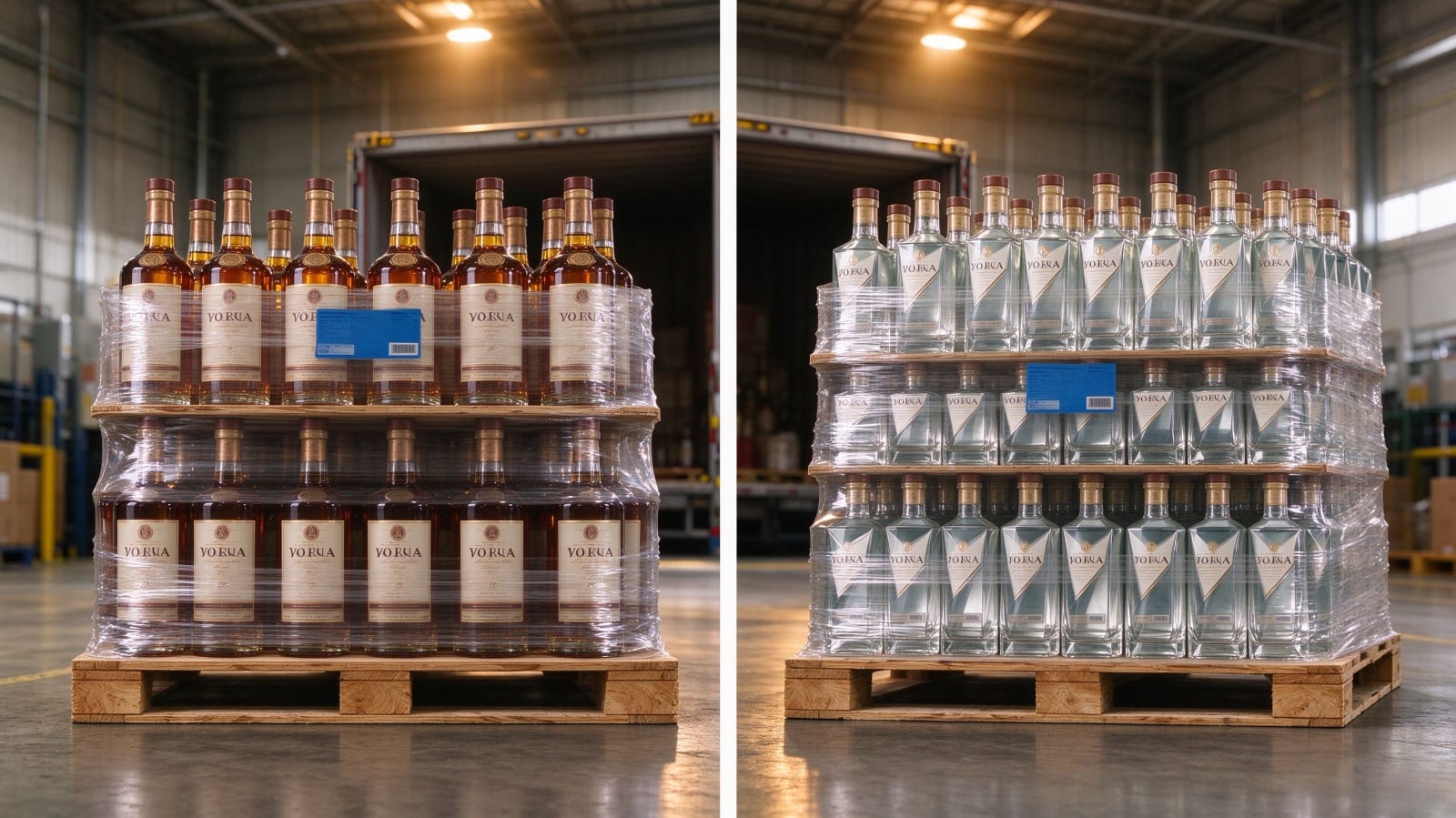
Lightweighting is fundamentally a logistics strategy. Lighter bottles mean more units per pallet, lower fuel consumption per unit shipped, and reduced freight cost per bottle.
The Red Dot Award-winning 260g bottle—developed by LiDA and Portuguese glassmaker Santos Barosa—demonstrates the ceiling of this logic. The bottle achieves over 30% weight reduction with up to 80% recycled glass content. Its more compact geometry allows 115 additional bottles per pallet, increasing transport efficiency by 7% and contributing to an overall 40% reduction in CO₂ emissions across the bottle's lifecycle.
Verallia has pursued a parallel approach, designing lightweight spirits bottles that do not require divisions when packed onto a pallet, increasing the average pallet load by 200 bottles. The logistics gain is not solely about weight—it is about how the bottle's geometry interacts with the pallet configuration.
Industry estimates place the transportation cost savings from lightweight bottles at up to 10%, with actual savings dependent on shipping distance and mode.
The Breakage Question: Where Lightweighting Goes Wrong
The legitimate concern among spirits bottle procurement managers is that reduced wall thickness increases breakage risk during transit and handling. The evidence is nuanced, and it points to a clear boundary between engineering-led lightweighting and indiscriminate weight removal.
On the positive side, benchmark analysis of ecommerce spirit shipments found that switching from traditional 500g bottles to optimized lightweight variants in the 380–420g range reduced average shipping damage rates by 37%, while cutting per-unit logistics cost by $1.28. The 405g specification achieved a 94% drop-test pass rate, compared with 72% for the standard 500g heavy bottle. The reason is that thickness distribution—particularly a reinforced base and tapered shoulder—matters more than total glass weight for structural performance.
The boundary becomes visible when weight reduction is pushed without corresponding structural optimisation. One European spirits brand that pushed a 700ml shoulder-heavy design below 365g experienced a 22% spike in breakage during palletized rail transit. The lesson is not that lightweighting is risky. It is that lightweighting without engineering validation is risky.
For B2B buyers, the practical safeguard is to require drop-test data (ASTM D4169 or equivalent), vertical load strength data, and internal pressure resistance data for the specific lightweight specification, benchmarked against the standard-weight equivalent. A supplier that cannot provide this data for a spirits application is not a viable lightweighting partner.
Logistics savings should be modelled at the container and pallet level, not just per bottle. A 7% transport efficiency gain from improved pallet density may deliver more value than a 10% glass weight reduction that requires custom dunnage. Simultaneously, the breakage risk threshold must be established through supplier-provided test data, not assumed from weight alone.
3. Sustainability: Beyond Carbon, Toward Market Access
Glass production is energy-intensive, and transport weight is high. For most spirits brands, the bottle dominates Scope 3 emissions. Diageo's design team has quantified the relationship simply: a reduction of 1g of glass equates to more than half a gram less of carbon emissions produced during production.
The compounding effect across a portfolio is substantial. Pernod Ricard's Chivas Regal 18-year-old redesign was 25% lighter, a change expected to save more than 500 tonnes of glass annually based on fiscal 2024 volume sales. Ardagh's lightweight 500ml bottle for Hernö Gin, weighing 480g—100g lighter than its predecessor—combined with increased recycled cullet content to deliver a 31% decrease in carbon emissions per bottle.
For sustainable spirits packaging buyers, lightweighting is the single most impactful lever available at the bottle specification stage.
The Consumer Perception Shift
The historical objection—that lighter bottles feel less premium—is weakening, and the evidence is now empirical rather than anecdotal.
A study by Mind Insights at the University of Louvain, in partnership with Verallia France, examined consumer perception of lightweighted bottles across six product segments. The researchers noted that earlier studies establishing a positive correlation between weight and perceived quality were conducted "a decade ago when environmental awareness among consumers was still in the nascent stages," and that their conclusions "are no longer necessarily valid in the current market". Critically, those earlier studies presented substantial weight differences between "lighter" and "heavier" bottles; the moderate weight variations produced by contemporary glassmakers—such as Verallia's 2–11% lightweighting for Mount Gay rum and St-Rémy—operate in a range where perception effects are attenuated.
Blind consumer testing reinforces the point. In a study of 1,247 consumers, 89% rated a 405g lightweight bottle as "premium" or "luxury," matching perception scores of heavier counterparts. The researchers attributed this to thickness distribution: a reinforced base and tapered shoulder deliver rigidity where it counts, independent of total weight.
Brockmans Gin offers a market-validation data point. The B Corp-certified brand introduced a bottle containing 30% less glass than competitors, weighing 500g.

Sustainability is shifting from a differentiator to a market access condition. With EPR schemes expanding and premium retail buyers increasingly requesting packaging carbon data, lightweight glass packaging is becoming a baseline specification rather than an optional initiative. Brands that can document measurable carbon reduction through lightweighting gain a defensible position in sustainability-conscious markets and a lower compliance cost profile.
4. A Procurement Framework: Balancing the Three Dimensions
For liquor bottle importers and brand owners evaluating a lightweight transition, the decision should be structured around a five-year total cost of ownership model rather than unit price alone.
| Decision Factor | What to Specify | What to Verify |
|---|---|---|
| Glass unit cost | Lightweight specification vs standard equivalent | Supplier quote with weight per bottle stated in grams |
| EPR exposure | Estimated fee differential by market | Supplier confirmation of bottle weight for EPR reporting |
| Freight per container | Bottles per pallet and per container | Pallet loading diagram; container utilisation calculation |
| Breakage risk | Drop-test and vertical-load performance | ASTM D4169 (or equivalent) test reports for the specific SKU |
| Shelf perception | Premium cue retention | Supplier references or blind-test data for comparable specifications |
| Mould strategy | Existing mould availability vs new tooling | Mould amortisation cost per unit at projected volume |
The framework reveals a pattern: the cheapest lightweight bottle per unit is not necessarily the lowest-cost bottle per case delivered, and the lightest bottle is not necessarily the most sustainable once breakage waste is accounted for. The optimal specification sits at the intersection of validated structural engineering, pallet-level logistics efficiency, and documented carbon reduction.
5. Conclusion: Lightweighting Is Now an Engineering Discipline
The 2026 evidence base supports a clear conclusion. Lightweighting is no longer a sustainability gesture or a cost-cutting shortcut. It is an engineering discipline that separates suppliers with genuine NNPB capability and structural design expertise from those simply removing glass from a mould.
For custom glass bottle buyers, the sourcing implications are concrete. Specify lightweight options in the RFQ from the outset. Demand mechanical performance data for the exact specification. Model savings at the pallet and container level, not the bottle level. And prioritise partners who can demonstrate that "lighter" and "no compromise" are not competing objectives—but a single, validated engineering outcome.
6. Call to Action
Ready to transition to a lightweight bottle without compromising premium shelf presence or filling-line performance? Send us your current bottle specification and target weight reduction. Our engineering team will review the structural feasibility, pallet loading implications and required test data — and come back with a total cost of ownership model within 5 business days.
Whether you need a lightweight whiskey bottle, an ultralight vodka bottle, or a custom spirits bottle with complex geometry, we handle mould design, glass forming, structural optimization and inspection in-house. One partner, one timeline, one point of accountability.
Send Us Your Bottle Specification and Target Weight
We will review structural feasibility, provide the necessary drop-test data, and model total cost of ownership at the pallet and container level — no obligation, no generic promises.



 Hot News