EN


The global spirits bottle market is not simply growing — it is bifurcating. Understanding where volume growth is concentrated, and where value growth is accelerating, is essential for any B2B buyer planning capacity or sourcing strategy for 2026 and beyond.
This article synthesises the most current market data to help liquor bottle importers, private-label project managers, and packaging procurement teams identify where the real opportunities lie.
1. A Market in Structural Transition
Two forces are reshaping the spirits bottle market simultaneously. First, global premiumisation is pulling value upward — consumers are drinking less but spending more, and packaging is where that premium is physically signalled. Second, sustainability regulation and freight economics are pulling weight downward — lighter bottles that reduce carbon footprint and shipping cost are becoming the default for premium brands.
For B2B buyers, the strategic implication is that "standard" bottles are becoming a commodity play while "decorated, lightweight, custom-moulded" bottles are becoming the value driver. Suppliers who can only offer the former will compete on price. Suppliers who can deliver the latter will compete on capability.
Premium and lightweight. Sustainable and distinctive. Custom and manufacturable at scale. The winning suppliers in 2026 will be those who can reconcile all three pairs — not pick one side.
2. Market Size: Multiple Lenses, One Direction
Market sizing figures vary depending on scope definition, but the directional signal is consistent across all three lenses:
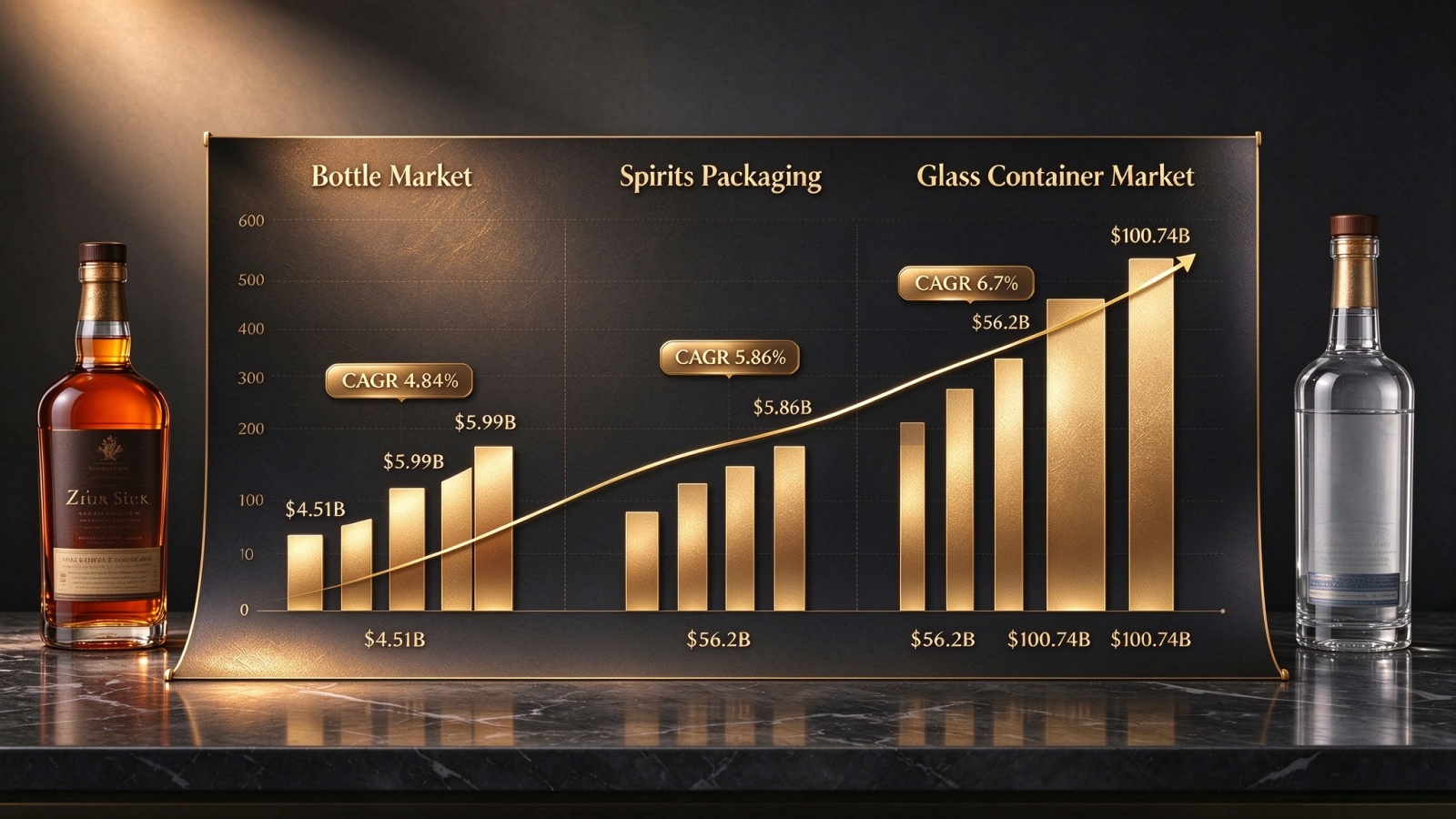
| Market Scope | Base Value | Forecast Value | CAGR |
|---|---|---|---|
| Broad liquor bottle market | $4.51B (2025) | $5.99B (2031) | 4.84% |
| Expanded glass container market | $56.2B (2024) | $100.74B (2033) | 6.7% |
| Spirits packaging (incl. closures & labels) | — | 2026–2032 | 5.86% |
The discrepancy between these figures is not contradictory — it reflects different scope boundaries. For B2B buyers, the key takeaway is that the glass bottle segment is growing faster than the broader packaging market, driven by premiumisation and the substitution of glass for alternative materials in high-value spirits categories.
The single most powerful driver of liquor bottle market growth is premiumisation. As consumers place greater emphasis on quality over quantity, beverage manufacturers are prioritising high-grade, aesthetically unique glass packaging to distinguish their high-value products in a competitive retail environment.
The financial evidence is compelling. In the US market, revenue for high-end Tequila and Mezcal suppliers grew by 7.9% to USD 6.5 billion in 2023, reflecting sustained investment in premium packaging. The premium spirits glass bottle market alone was valued at USD 7.4 billion in 2024 and is projected to reach USD 11.6 billion by 2034, growing at a CAGR of 4.60%.
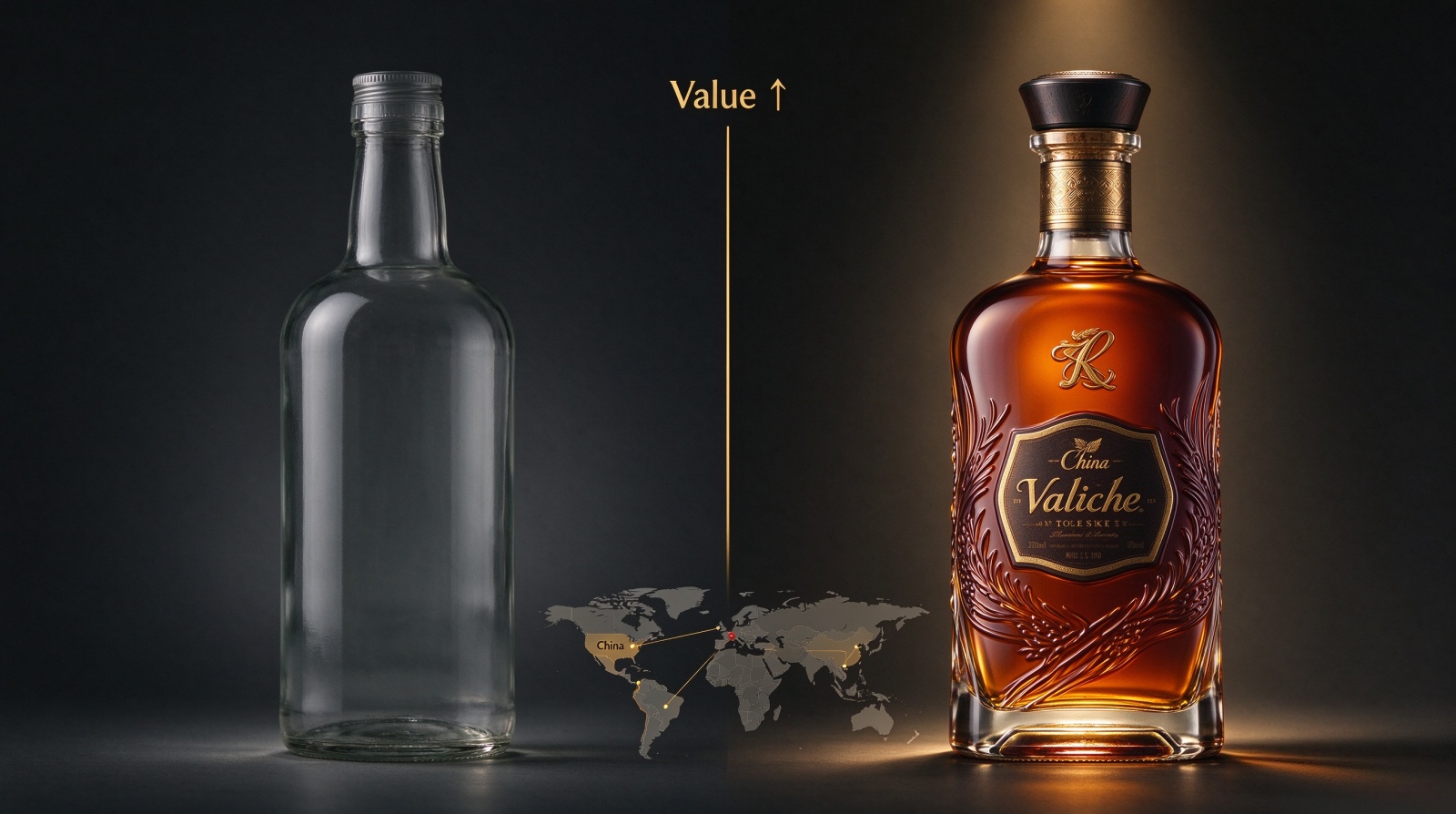
Critically for suppliers, premium packaging — decorated, screen-printed, and custom moulded bottles — captures an estimated 40–50% of total market value despite representing only 15–20% of unit volume. This value-volume divergence is the defining economic characteristic of the spirits bottle market in 2026.
A decorated, custom-moulded bottle can capture 3–4× the value per unit of a standard bottle — even though both start as the same raw glass. The premium does not come from the glass. It comes from the mould, the embossing, the decoration and the closure.
4. Regional Opportunities: Where to Focus
Each major region presents a distinct strategic profile. The table below summarises the key data points for B2B sourcing decisions.
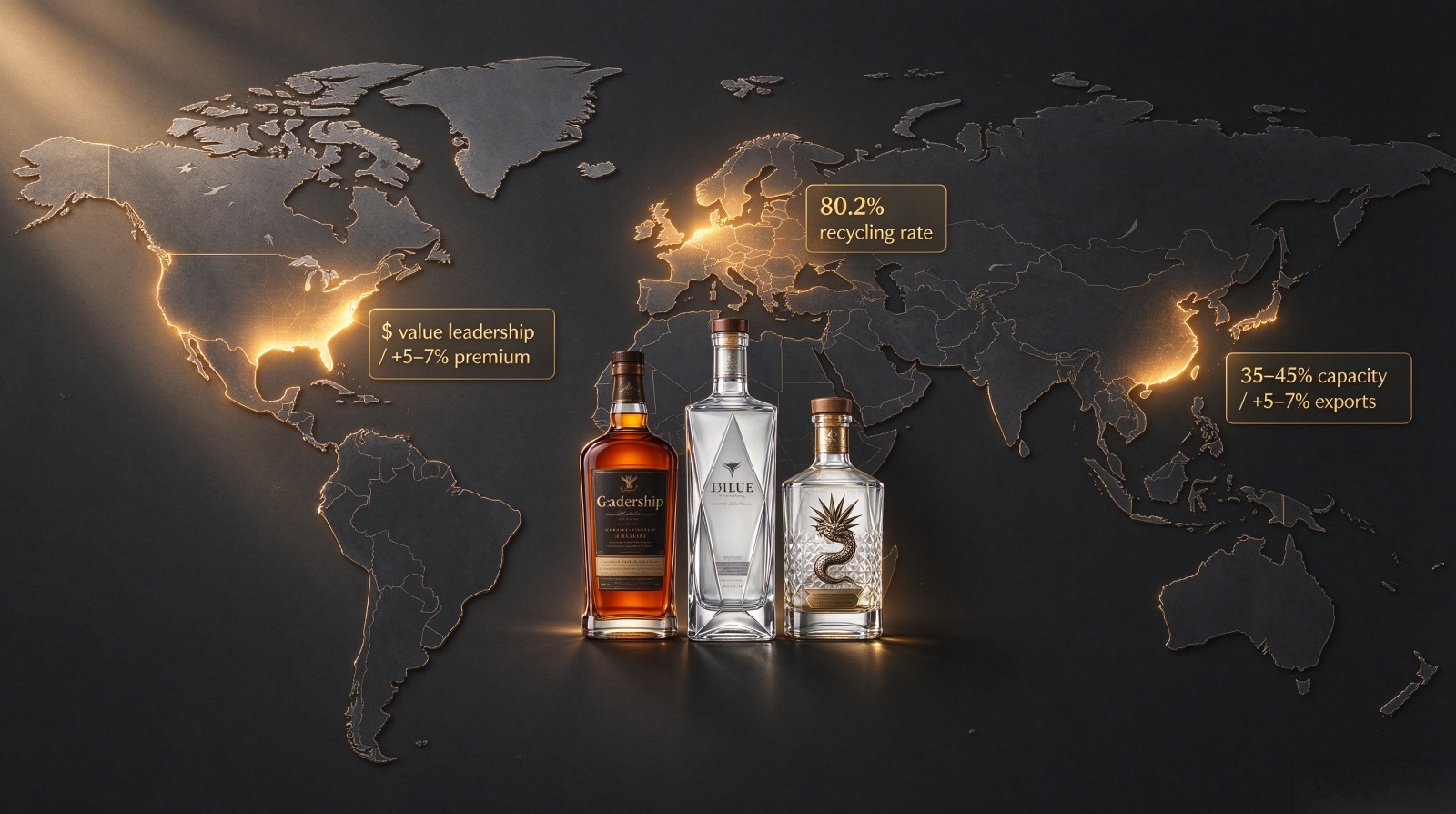
| Region | Key Metric | Strategic Implication |
|---|---|---|
| North America | Spirits consumption +2–3%/yr; premium bottle segment +5–7%/yr | Largest market by value; premium focus |
| United States | Lightweight glass adoption 20–25% today → 35–45% by 2035 | Lightweight becomes compliance baseline |
| European Union | 80.2% glass packaging recycling rate (2022) | High-cullet specs become competitive edge |
| China | Shandong accounts for 35–45% of total glass packaging capacity | Primary Asian sourcing hub |
| China exports | +5–7%/yr to SE Asia, Africa, Eastern Europe | Quality parity with EU glassmakers improving |
North America: Value Leadership
North America remains the largest market by value, supported by steady spirits consumption growth of 2–3% per year and increasing glass penetration in premium segments. The US spirit glass packaging market is expected to grow at a volume CAGR of 3–5% through 2035, with the premium bottle segment growing at 5–7% annually. Lightweight glass adoption is forecast to increase from 20–25% of bottle volume today to 35–45% by 2035, driven by both cost and sustainability pressures.
Europe: Regulatory Pressure, Recycling Advantage
Europe presents a different profile — higher regulatory pressure but also higher recycling rates. The EU achieved a record 80.2% glass packaging recycling rate in 2022, creating favourable conditions for high-cullet bottle specifications. For European spirits bottle buyers, the opportunity lies in sustainable premium positioning.
Asia-Pacific: Rapid Premiumisation, Sourcing Hub
Asia-Pacific, particularly China, is undergoing rapid premiumisation. The China spirit glass packaging market is bifurcating between high-volume, low-margin standard bottles and a rapidly expanding premium segment. Shandong province alone accounts for roughly 35–45% of total glass packaging capacity in China, making it the primary sourcing hub for custom glass bottle buyers seeking Asian manufacturing.
Export volumes from Chinese glass manufacturers to Southeast Asia, Africa, and Eastern Europe have grown at an estimated 5–7% annually, supported by competitive pricing and improving quality parity with traditional European glassmakers.
5. Strategic Implications for B2B Buyers
The market data points to three actionable conclusions for spirits bottle importers and brand owners:
Standard bottle production is overcapacitated, with utilisation rates estimated at 70–80% across the Chinese industry and persistent downward pricing pressure. Decorated and custom-moulded bottles, by contrast, command structural pricing power.
With US lightweight glass adoption forecast to nearly double by 2035, suppliers who cannot offer certified lightweight specifications will be excluded from an increasing share of premium contracts.
Import share in the US market may stabilise around 28–33%, with nearshoring favouring Mexican supply and Chinese imports facing ongoing tariff uncertainty. Dual-sourcing strategies are becoming standard practice for major distillers.
6. Call to Action
Planning your 2026 sourcing strategy across multiple regions, or reviewing whether your current supplier can deliver both lightweight engineering and premium decoration at scale? Send us your target markets and volume plan. We will come back with a regional supply assessment, capacity recommendation and lightweight feasibility review within 5 business days — no obligation, no vague promises.
Whether you need premium decorated bottles for North America, high-cullet recycled glass for Europe, or lightweight specifications for volume-focused Asian channels, we handle mould design, glass forming, embossing, decoration and inspection in-house. One partner, one timeline, one point of accountability.
Tell Us Your Target Markets — We Will Map the Right Supply Chain
Share your target regions, annual volumes and premium positioning. We will come back with a regional supply assessment, capacity recommendation and lightweight feasibility review — no obligation, no generic sales pitch.


 Hot News