EN


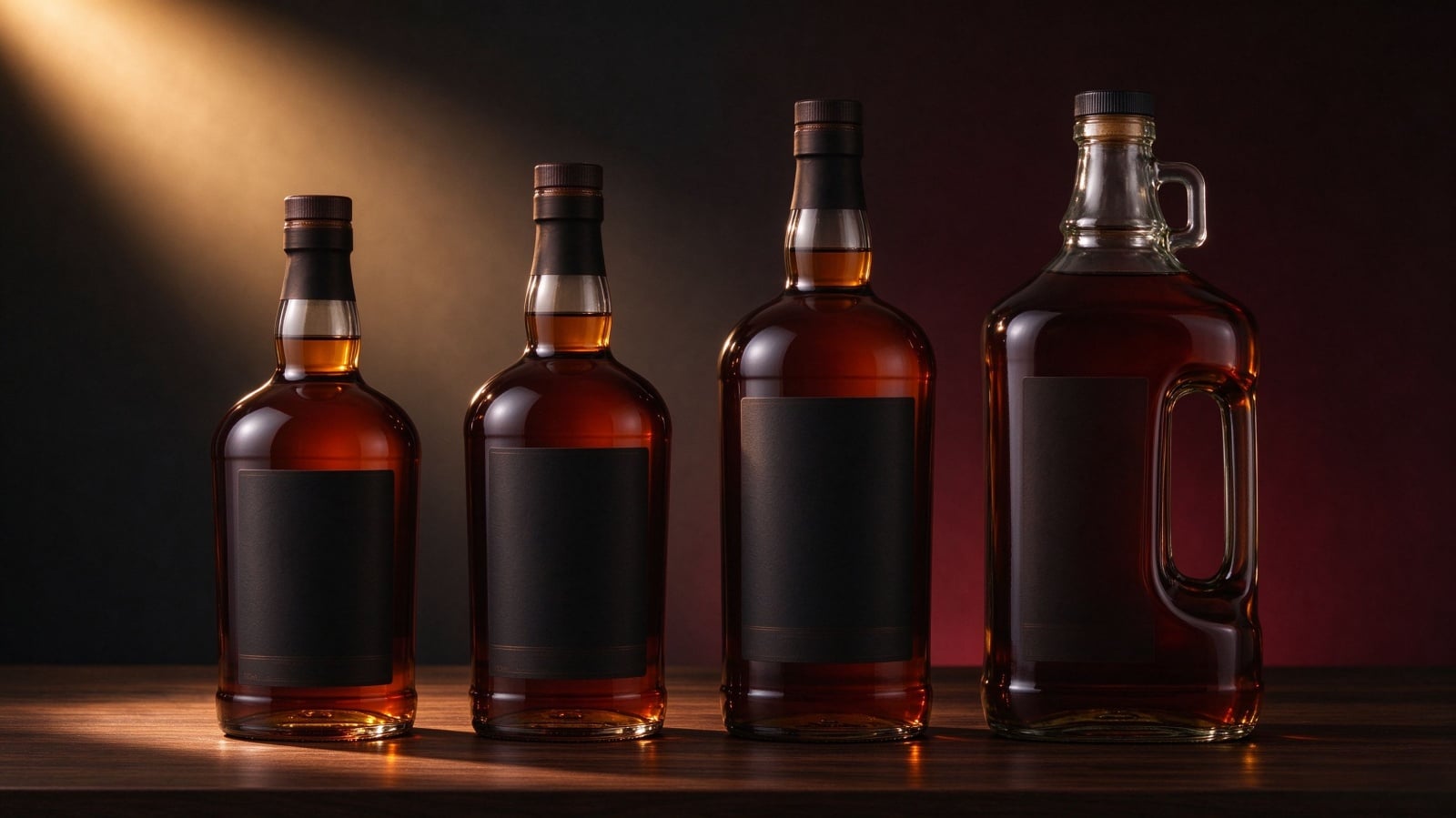
Bottle size is the first sourcing decision that locks in a brand’s legal access to a market. A 750ml bottle that sells without friction across North America is not a legal retail format in the European Union. A 700ml bottle that satisfies EU law has only recently become an authorized U.S. standard of fill—but it still fights against decades of American shelf convention. For liquor bottle importers and private-label project managers, choosing between 700ml, 750ml, 1L and 1.75L is not a volume preference. It is a compliance decision with direct cost consequences for moulds, filling lines and freight.
1. The U.S. Framework: TTB Authorized Standards of Fill
The U.S. regulates distilled spirits container sizes through 27 CFR 5.203, which operates as an authorized list rather than a minimum-or-maximum range. The current eCFR text authorizes a wide array of sizes, including 3.75L, 3L, 2L, 1.8L, 1.75L, 1.5L, 1.00L, 945mL, 900mL, 750mL, 720mL, 710mL, 700mL, 570mL, 500mL, 475mL, 375mL, 355mL, 350mL, 331mL, 250mL, 200mL, 187mL, 100mL and 50mL for distilled spirits, whether domestically bottled or imported.
Critically, 700mL now sits on that list alongside 750mL and 1.75L, which means a brand can legally use a single 700ml mould for both U.S. and EU retail—if it accepts the commercial trade-offs.
750ml remains the dominant U.S. retail and bar format, and 1.75L carries the strongest recognition in value retail. A 700ml bottle is legal in the United States, but it is not the size a U.S. distributor, bartender or shelf planner instinctively reaches for. Legal permission and commercial normality are not the same thing.
2. The EU Framework: 700ml Is the Only Retail Spirit Size That Includes the U.S. Overlap
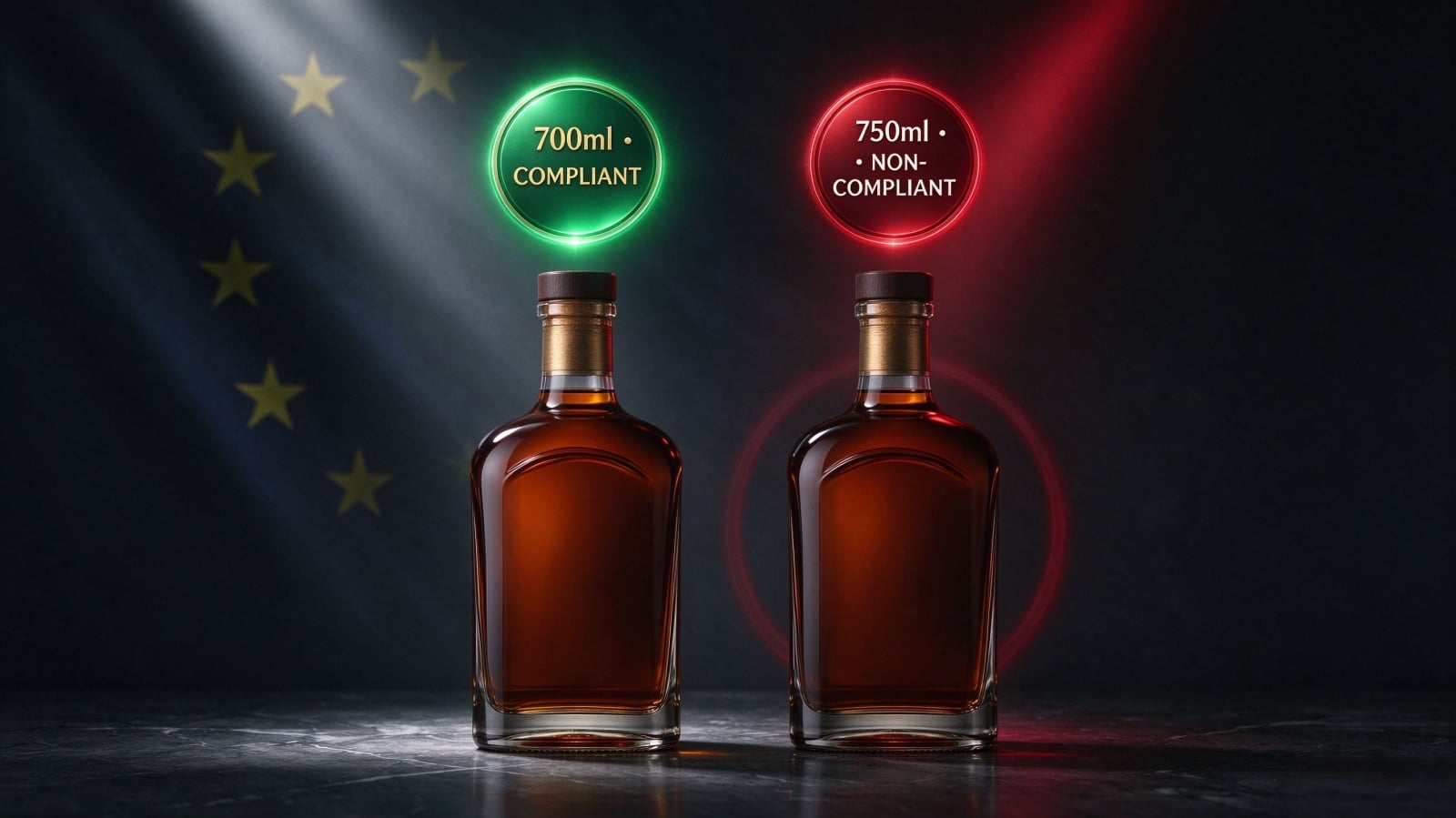
EU rules are stricter. Under Directive 2007/45/EC, spirit drinks sold in the EU may only use nine nominal quantities between 100ml and 2,000ml: 100, 200, 350, 500, 700, 1,000, 1,500, 1,750 and 2,000ml. 750ml is not on that list and remains non-compliant for EU retail.
There is one important exception that B2B buyers routinely miss: the Directive does not apply to pre-packaged products sold in duty-free shops for consumption outside the European Union. This creates a bifurcated EU strategy. Retail and domestic on-trade require 700ml. Duty-free and travel retail can legally carry 750ml or 1L because the product is destined for consumption outside the EU market.
For a brand selling into both EU and U.S. retail, 700ml is the only volume that satisfies both regulatory regimes without a separate mould. The cost of that regulatory shortcut is U.S. channel familiarity; the cost of rejecting it is a second mould and a second filling-line setup.
3. Large Format: 1L, 1.75L, 3L and 3.75L by Channel Function
Large format bottles follow a different logic from standard retail. They are chosen for visibility, gift value, travel-retail fit or VIP service, not for shelf-volume economics. The table below maps the dominant B2B use cases.
| Size | Common Name | Primary B2B Use | Key Sourcing Consideration |
|---|---|---|---|
| 1L | Liter bottle | Duty-free, bars, hotels, premium travel retail | "Familiar, practical, and travel-retail friendly" — easiest large-format entry point |
| 1.5L | Magnum | Premium gifting, limited editions, luxury releases | Strong collectible appeal; medium design risk |
| 1.75L | Handle / value-size | Retail value packs, vodka, whiskey, rum | Strongest U.S. value-retail recognition; maximum TTB-approved spirit size is 1.75L |
| 3L | Jeroboam-style | Nightclub VIP service, promotional display, events | High visibility; bottles of 3L or larger are not approved TTB sizes for spirits and cannot legally be sold as standard U.S. retail spirits |
| 3.75L | Extra-large display | Luxury gifting, special releases, collector editions | Very high design and freight risk; display-first, not volume-first |
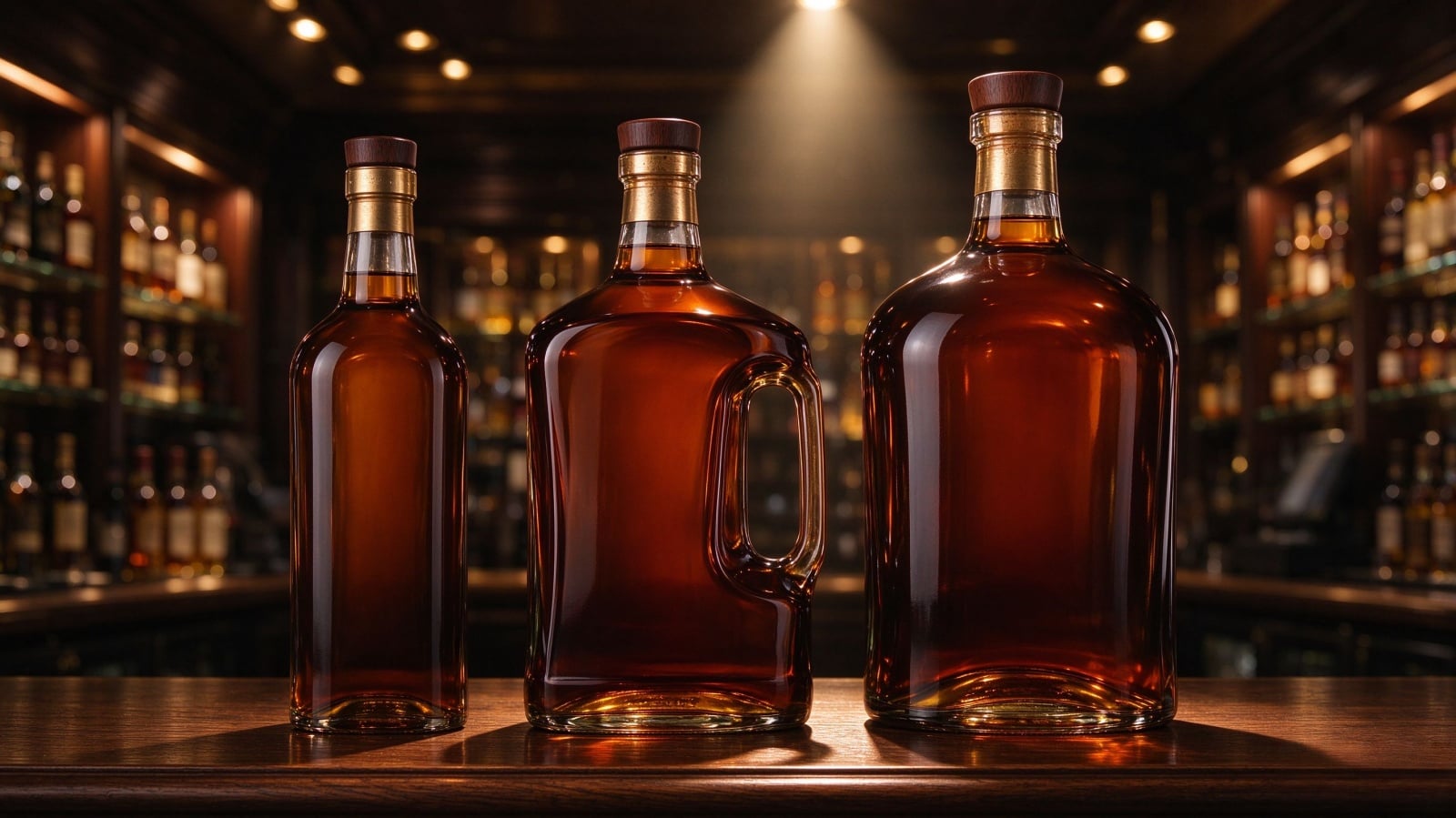
For large format spirits bottles in duty-free, 1L is the default because it aligns with travel-retail expectations. For nightclub display bottles, 3L delivers VIP visibility but must be planned as a display or on-premise asset in the United States rather than a standard retail SKU. For value retail, 1.75L is the format with the deepest consumer recognition. A 1.75L decanter-style bottle can weigh over 2kg empty, and freight cost scales with that weight.
4. The Hidden Cost: Filling-Line Changeover
The most underestimated B2B cost in a multi-size strategy is filling-line changeover. A 700ml and a 750ml bottle may share a compatible neck finish such as 30/60, but the height difference between the two formats can trigger a "changeover day" on an automatic line, with adjustments to capping, labelling and case-packing equipment. Some producers run 700ml and 750ml on the same line with tool-free, colour-coded change parts; others face substantially longer downtime because the bottle height falls outside the filler's rapid adjustment window.
Confirm filling-line compatibility before the bottle design is frozen, not after. Request the bottle height, diameter, neck finish and base geometry for each candidate size and test them against the actual filler and capper specifications. A mould that saves $0.03 per bottle can be erased by a single extra changeover shift.

5. Decision Framework for B2B Buyers
The choice of bottle size should be made based on regulatory access, channel economics, and mould amortization. The table below provides a quick-reference decision matrix.
| Buyer Profile | Recommended Primary Size | Rationale |
|---|---|---|
| EU retail only | 700ml | The only compliant EU spirit retail size among the standard options |
| U.S. retail only | 750ml (core) + 1.75L (value) | 750ml is the commercial default; 1.75L captures value retail and remains TTB-compliant |
| EU + U.S. retail | 700ml | One mould, two legal markets; accept U.S. channel education cost |
| Duty-free / travel retail | 1L (primary), 750ml (EU duty-free exception) | 1L is the travel-retail entry format; EU duty-free can legally carry 750ml |
| Nightclub / VIP display | 3L for display; 1.75L for service | 3L for visibility (U.S. non-retail); 1.75L for speed-rail and service economics |
6. Bottom Line
Choose the size by regulatory market access first, channel economics second, and mould amortisation third. 700ml is the EU compliance answer and the U.S.–EU overlap. 750ml is the U.S. commercial answer but not an EU retail answer. 1L and 1.75L are channel-specific tools: travel retail and value retail respectively. 3L and 3.75L are display and gifting formats that should be costed as brand-building assets, not as standard SKUs.
7. Call to Action
Specifying a new bottle size for a multi-market launch? Send us your target regions, channel mix, and volume requirements. Our engineering team will provide a regulatory compliance matrix, a mould amortization plan, and a filling-line compatibility report within 5 business days — no obligation, no vague promises.
Whether you need a 700ml EU-compliant bottle, a 750ml U.S. standard, a 1L duty-free format, or a 1.75L value handle, we handle mould design, glass forming, decoration and inspection in-house. One partner, one timeline, one point of accountability.
Send Us Your Target Markets and Channel Strategy
Share your target regions (US, EU, Duty-Free) and volume plan. We will come back with a regulatory compliance matrix and a total cost of ownership model — no obligation, no generic sales pitch.




 Hot News